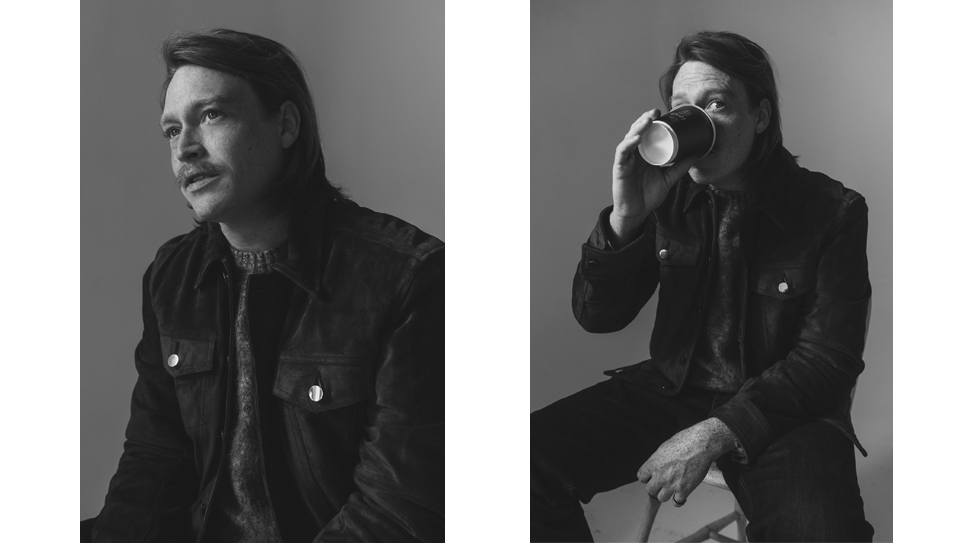

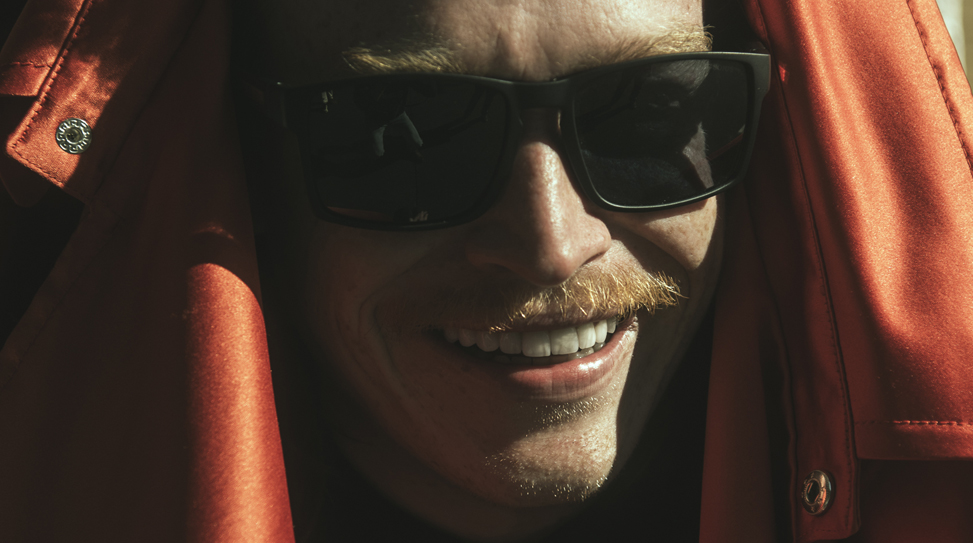


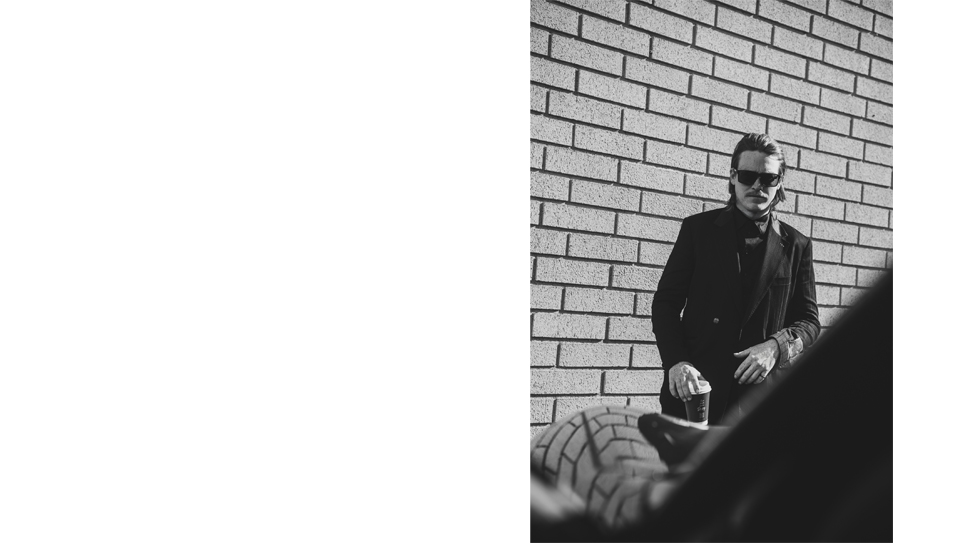
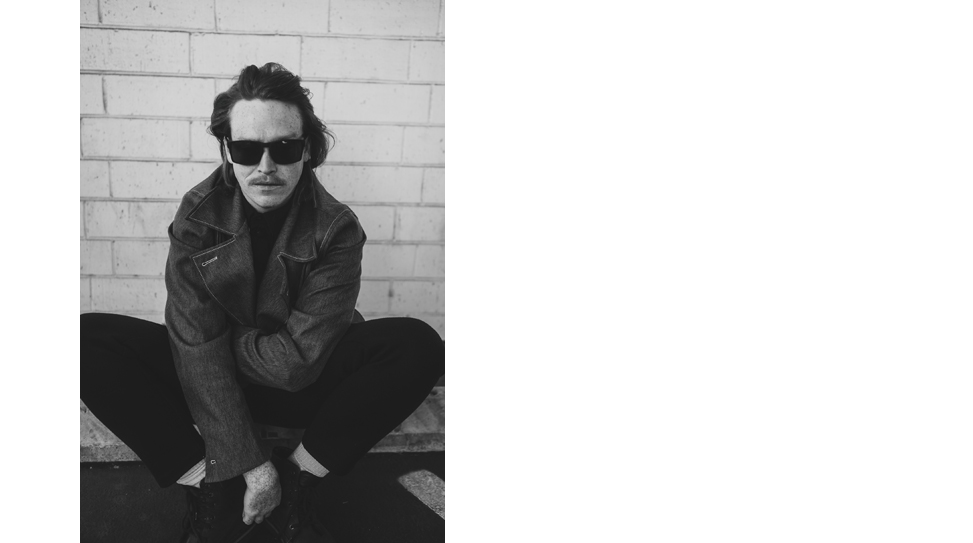
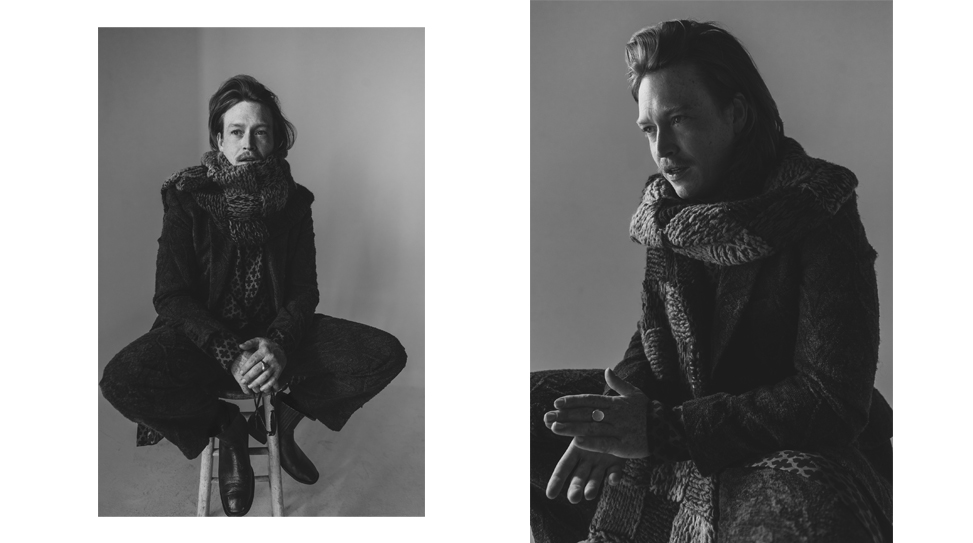

With everything I’ve done, I’m always freaking out. But with each job, I’m learning more and more. I’m learning to trust myself more. I also trust others more. Still, it’s always a panic.
You Might Also Like
 I’m Still Here
 Endangered Species
Photography by Reto Sterchi
Styling by Alvin Stillwell at Celestine Agency
Grooming by Olaf Derlig at Atelier Management
Produced by Jesse Simon
Location: MVMT Studios
Global Brand Ambassador: Kee Chang
Special Thanks to Chelsea Peters
There is no place for vanity in acting. There shouldn’t be, anyway. Vanity interrupts truth. If actors prioritize storytelling—surrender their ego so fully that characters breathe on their own—nothing really stands in the way of true greatness. That is the miracle of someone like Caleb Landry Jones.
Sitting down with Jones, you are bound to lose yourself in a winding, ambulatory exchange. To dispel any misunderstanding, that is an endearment. He chuckles generously, as if surprised to rouse dormant thoughts along the way. That inchoateness—and a freckled, translucent visage curiously shifting between Luciferian beauty and boy next door—is transfixing. These are qualities he has no doubt co-opted, consciously or not, to chalk up an enviable gallery of unrivaled performances over the years. As evidenced by Jones’ metamorphoses, especially that of lost boys, douchebags, and outsiders—in Brandon Cronenberg’s Antiviral, Jordan Peele’s Get Out, David Lynch’s Twin Peaks revival, the Safdie brothers’ Heaven Knows What, Justin Kurzel’s Nitram, which earned him the Best Actor gong at Cannes, to name a few—he is nothing if not committed. A director’s actor, he also continues to attract some of the best co-conspirators cinema has to offer.
So it seems only fitting that Luc Besson would tap Jones for Dracula, a bold new take on Bram Stoker’s timeless classic, which marks their second collaboration after Dog Man, with another one, a passion project called Down the Arm of God, on the way. As the titular blood-sucking count, he certainly looks the part. Let’s also consider Jones’ known allergy to needless gore and violence in entertainment. Besson’s version departs significantly from the 1897 source novel and most horror-leaning adaptations. The French filmmaker’s take is a sweeping period romance. The story follows a warrior prince who renounces God for failing to spare his beloved wife during a fierce battle. Swiftly inheriting a curse, the prince is transformed into Dracula and condemned to immortality. An implacable vampire, his only wish now is to unite with the reincarnation of his wife, setting him on a four-hundred-year odyssey from fifteenth-century Romania to modern-day Paris.
Dracula opens in select theaters on February 6.
Hi, Caleb. How are you doing, sir?
I’m doing good, man! I’m on babysitting duty.
It’s funny—we seldom think about actors doing stuff like that.
Yeah, looking for socks and stuff like that. [laughs]
Exactly. You know, I was just thinking about my first real entry into your work. I’m not exaggerating, saying, Heaven Knows What rejuvenated my love for movies. I was completely wide-eyed sitting in that theater at the New York Film Festival. I haven’t shut up about it.
That was a wonderful screening. It was probably the best screening of a movie I’ve ever been to.
With Josh and Benny [Safdie], I thought, “Here comes the next brilliant filmmakers.” And watching you, I thought, “This is somebody I’ll continue to watch for as long as I live.”
Oh, thanks, man…
You’re particular. That much seems clear. When I look at your body of work, it’s obvious that you choose carefully. It’s obvious that you want it to be worthwhile. How do you choose?
I feel like every time I try and talk about that, afterwards, I end up going, “That’s not how it is at all!” ‘Cause each job comes to you differently, whether it’s through an agent, your manager, a friend, or an acquaintance. So why do I do something? Sometimes it’s as simple as wanting to work with the director. Sometimes it’s both the director and the script. I find that, usually, if you like the director, chances are, you’ll probably like the script ‘cause the script tends to be about the thing they’re excited about doing. If not, you hope that you’ll get to talk about it and figure that out ‘cause maybe you’re not seeing it in the right way or whatever. I don’t know… That’s a hard one.
Choosing by director always seems most logical. About Nitram specifically, you’ve said this to me before: “I saw something in [Justin Kurzel] that told me it’s something I’ve been looking for since I was 16—wanting to be part of a Kubrick film. An Antonioni film. Pasolini.”
Well, with Justin, I didn’t know that until we were working together. ‘Cause I had just known Snowtown. I’d seen twenty minutes of that movie. So it was about being there, about a week in, where I was very much coming to the realization that this is the kind of thing I’d been searching for my whole career. And by that I mean I was working with a director who, for the most part, had my back. He gave me a freedom to play the character and not worry too much about what people might think of me. The Safdies gave me a lot of room in the same way. Then, after working on those films, I had this problem where I was trying to find that same kind of space to work in again.
Considering the material and what you’re tasked with, are you also feeling trepidatious?
Funnily enough, when Josh called me about their film, I think I was too stupid to think about those things. [laughs] I was just excited that there were these two younger filmmakers who were making some gritty stuff. And they apparently wanted me, you know? They were also down for me to—I don’t know if folks would call it Method, but they were into that it sounded like. So that was really exciting. I would have ideas and Josh would be like, “I’m not afraid of that. Let’s find it.” What I still can’t figure out is why he wanted me. I’d just done an X-Men movie, and what they were making seemed pretty raw, where the acting would be more on the realistic side of things.
Benny told me why: they were really taken by your audition tape for The Last Exorcism.
Oh, okay!
I mean, it wasn’t just that, right? According to Josh, there were a couple of names that were brought to their attention by [casting director] Jennifer Venditti. He said you were by far the most interesting in that group. He said, once he spoke to you, the choice was pretty obvious.
Okay, good! Yeah, probably ‘cause I was like, “Whatever it takes! Let’s do it!” But I also find that there are always things you miss while reading the script or looking at the film before you actually get there. So all of a sudden, you’re going, “Oh, right, I’m on a horse. I’m on a ladder. Oh yeah, this whole scene is of me being hung out of a window.” [laughs] Somehow, some of those things that might scare you, I don’t pay attention to right away. It must be a self-defense mechanism.
Dracula is another interesting choice for you. Where do you start with him?
In the beginning, it was about figuring out what Luc [Besson] wanted and going from there. He’s very specific in certain ways when it comes to an attitude or a feeling for the character, and the voice even. Then there’s the space to play around within those parameters. I very much enjoyed working with Luc. Working with everybody is different. They have an idea in their head and you’ve got a loose idea in your head. Getting those ideas to become the best thing they can be, or the strongest version of that, it doesn’t matter so much if you disagree or don’t see it in the same way. Usually, for me at least, the costume and prosthetic teams will help dictate things a lot more.
I had this idea that Dracula would come in on a fog. It’s such a stupid idea looking back on it now. They were like, “Oh, interesting, Caleb.” Then you put on the costume and realize that’s not gonna work ‘cause you’ve got this many inches to move your legs. You can take small steps, but you can’t glide or whatever, so that goes out the window. I remember trying to be stubborn with another idea, but that would mean changing things drastically. We don’t have time for that. Everybody’s under the wire as it is. As an actor, it’s a limitation… No, not a limitation—it’s a bad idea from the beginning. [laughs] It wasn’t gonna work anyway. Thank God they have something else in mind.
It’s never one choice. But sometimes there’s one choice that makes all the other choices happen faster. Josh would be like, “Here’s your coat and shirt. That’s the costume.” You put it on and it does something. It always does. It never fails. You don’t figure everything out, but it starts you on your way. The voice, how the character spends their time—all those things start to inform you more as to what to do. Then, hopefully, when you’re on set, when they’re going, “What would the character do?” you go, “Let me show you,” and it’s right. I think that’s one of the best things. That makes me feel like we’re fine. It’s like, “Maybe we’re not as lost as I thought!” Then, an hour later, maybe you’ll feel just as lost again. It’s about reassurance or something. Sometimes when you’re asked, “What would the character do?” instantly, you have a gut feeling. It feels like all that other work you did has put you in this place of listening to that gut feeling. You can listen to that gut ‘cause gut is not ego, you know what I mean? It’s about what’s right for the character. And that could be different from what the director wants, too. It’s really all about, “How do we find it?”
Correct me if I’m wrong: it wasn’t always Dracula, right? I think Luc had been talking to you about collaborating on another project while you were still filming Dog Man. From what I understand, he wanted to find your next role, which he would direct. A czar, or even God?
Hmm… I think Luc and I have different memories of it. I just remember him asking what part I wanted to play. He asked, “What’s something you wanna play that you haven’t gotten to yet?”
What a dream scenario for any actor.
And I didn’t have anything that came to mind! Then he bought up Dracula. I don’t think he was set on making a Dracula movie while we were talking like that, but it started us on something. When we finished Dog Man—however many months after that, I forget—there was a script.
You have Down the Arm of God on the way, too, which he produced. You’re like his muse.
Oh, well, I respect him a lot. He’s one of a kind. I’ve been lucky enough to work with incredible directors and some masterful directors. Luc reminds me more of working with someone like John Boorman [Boorman directed Jones in 2014’s Queen and Country.] There’s an intensity to working with him that is of an older school. There’s a dedication to the project that I admire so much. He has perseverance. His eye never falls off the ball at any point. It’s a really remarkable thing to see.
When you say “muse,” I never know what to think that word really means. [laughs] I’ve been looking for the kind of relationship we found with each other since I came to Los Angeles. I was obsessed with De Niro from Taxi Driver, and how much he changed in Raging Bull and The King of Comedy. I was also so much inspired by Tim Burton’s work with Michael Keaton—to know that Beetlejuice and Batman were played by the same person. This kind of work, to be able to change like that, always really inspired me. I’d been hoping to find, in an earnest and genuine way, these relationships with folks that will wanna see what we can do together. I’ve been lucky, more often than not, to work with directors that I find a very quick language with. And when you find that, you’re always hoping something else will come down the pipeline. You’re hoping that it’ll be six months or a year later. But in the fifteen or sixteen years of doing this, I found out how rare that is. So it is very special when someone like Besson comes back and says, “We did dogs. Now let’s keep you up in a tower for four-thousand years.” It’s really exciting as an artist. It means a lot to me as a person, too—the kid in me and what I was looking for when I came out to LA. I’d fallen in love with Johnny Depp and Daniel Day, actors that you see working with one director several times over, and the range in which they work. It’s inspiring and very refreshing when you see it.
I’m sure those winning qualities you admire in Luc are qualities he sees in you as well.
All we’re thinking about is the movie while making it. We’re both curious. There are things that I’ve found, and there are other things he’s capable of. I don’t know where he gets the energy and focus I wish I had. But there is something about our drive. We will do everything for the movie.
You even share common ground in approach to horror. You both dislike gore and violence.
Yeah, we share that in common, too. We don’t like what most folks would call horror, I guess. I always loved how some of those guys like Lon Chaney and [Christopher] Lee and Boris Karloff were so upset with the term “horror.” They looked at it differently, too. They looked at it much more emotionally and, of course, from the perspective of actors, which means much more personally, you know? Intimately. That I love very much. I think that’s why their portrayals are so special. It’s because they brought something of themselves into the part and took it seriously.
This is a version of Dracula I hadn’t seen before—it’s so much a love story. The film endeared me to him like never before because we spend real time with him. That he would search for his lost love for four-hundred years is incredibly romantic. We all know love.
Very much so.
I hate to compare things, but it reminded me of that 90s Robin Williams movie What Dreams May Come. He literally journeys to hell to find his wife again. I eat this stuff up, Caleb!
Oh, me too. I think they showed that in junior high. It was in English class or something, probably ‘cause of the reference to Dante’s Inferno. I was blown away by the colors in that movie. That was pretty exceptional. And Robin Williams—what a remarkable actor. I forget who directed that film… I’m gonna kick myself when it comes to me later. Son of a dog!
His name is escaping me, too. [It was Vincent Ward.] He’s another visionary, that’s for sure.
That was some good work. I’m sure it was a hard movie to make. I think it was a studio film, too.
Whether it’s Dracula or What Dreams May Come, the motivation is clear: love. In the past, you told me what felt familiar about playing a mass shooter in Nitram was the loneliness. We all know loneliness, too. Have there been roles where you just couldn’t find your way in?
I think all of them, man. With everything I’ve done, I’ve been panicking. I did one movie where I played a robot [2021’s Finch], and the voice didn’t come to me until that morning, just before the read through with the producers and the director. I’m always freaking out, usually even after the movie is over. At least when you’re on set, you really have no time to worry at a certain point ‘cause now it just has to get done, so that helps a lot. ‘Cause we have to succeed! [laughs] But I think with each job, I’m learning more and more. I’m learning to trust myself more. I also trust others more. Still, it’s always a panic. I’m always grasping at straws, not knowing what to do.
On Nitram, I didn’t know what to do until Justin asked me to make some videos. That meant I was dancing every day to music. And through dancing, I was learning that I would wear myself out physically to the point of throwing up. It sounds stupid, but it felt like this was the place I was trying to get to with the character. Dancing suddenly unlocked movement and all these other mannerisms. Something clicked. Then, as I was saying before, other things started clicking, too.
On Dracula, Luc slowly integrated different things. There was sword fighting. That meant getting with a team and learning how to do that. The armor meant I needed to get used to that. I’m gonna be on a horse, so the more I know about horses, the better. The katana meant that gets brought into the choreography. So you’re doing all of these things, and maybe those things carry into something else, like forcing you to stand differently. I also worked with a dialect coach, Kohli [Calhoun], for three months before shooting. But even that didn’t start to find itself until I got the teeth in. Before you know it, you’re in makeup, and you still don’t know how you’re supposed to play Dracula…
All that is to say, I’ve never started a job feeling a hundred percent certain that I know what it is I’m supposed to do. There’s an actor named David Suchet and he talked about understanding his puzzle piece in the bigger puzzle. If he removed his character, what is it missing? I found that to be very helpful. Sometimes it’s as simple as that. I hate to simplify things ‘cause it’s always more complicated than that, but sometimes it’s as simple as dancing that unlocks a walk and behavior.
Would it concern you if things clicked right away? Would you find that highly suspicious?
Early on in my career, let’s say I bought clothes ‘cause I was so sure that this is how the character would dress, without talking to the director or anything. There have been a few times where I’ve been told, “Get rid of all that.” That’s the worst, especially if you’ve been doing a lot of work on it. But I’ve gotten better at learning to adapt more, trying not to solidify things too much or assuming things ahead of time. Nothing’s a waste of time ‘cause it always ends up helping somehow, but time is precious. At some point, you can start wasting time by doing the “wrong” work or whatever that means. Your locations can change. Sometimes the cast changes. You always have to be ready to go with the flow to find what you’re looking for. Sometimes you find it in a rehearsal. Sometimes you find it a month into shooting. And that’s scary. I don’t like that feeling. And I don’t think I’ve ever finished a movie and gone, “I understand this character. I know what I’m doing.” It always feels like there’s more things to explore. And sometimes you can finish a job and suddenly have those emotions the character had, and you’re pissed off because there’s no cameras rolling. It’s like, while you were filming, you were working to bring them up, rather than letting them happen. It’s always gonna be much more interesting to watch someone coping, rather than pushing.
When you’re helping to steer the ship a lot more, like on this upcoming film Down the Arm of God, which you co-wrote with Peter Brunner [Brunner directed Jones in 2018’s To the Night], the endeavor must feel far less alien to you. This has been described as your passion project.
After Heaven Knows What, I wanna say that this is another opportunity I’ve had in working with a director where I have this freedom to find the character—to really live the character out. There’s actually probably been a handful of jobs where it’s been like that for me. Luckily, it’s become more frequent in the last five years. Peter and I have been trying to figure out how to work together again as well. This is a project he put together that I joined. He wrote the initial draft and then we wrote another draft. I just helped a bit. Then we couldn’t get the movie made. The movie is a big mirror that reflects where we are now. It’s about the homeless. It’s about our broken structures. It’s about religion and the hypocrisy in the church. We’re trying to talk about a lot of big things at once.
All the mess that we find ourselves in.
Yeah. I’m proud of the movie. It was a hard movie. We spent four, five years trying to get it made. We couldn’t get the money ‘cause we were trying to make it with real people. We wanted these folks to play themselves to a degree and not whitewash what is going on. We felt that the only way to do that was to work with real folks who knew something about it firsthand. Luc came on board and gave us all the money to make the movie. We’re so extremely grateful to him for doing that. This movie is a big deal to me. It’s about something that everyone was telling me they cared about. But at the end of the day, it felt like something no one was willing to take a chance on. It was something everyone seemingly wanted to champion, but they weren’t willing to take the risk.
Because you’re working with the houseless community, it called to mind Heaven Knows What again. From what the Safdies told me, you were upset when they gave you a hotel room on that film because, if you were to play a kid on the streets, you wanted to be living with them.
‘Cause then I feel like I’m getting closer. The only way I know how is to try it out. At some point, you can’t just try it out in your head anymore, you know? I’ve never been good at wiggling in the in-between. I watch something like the behind the scenes of The Wolf of Wall Street and I can’t figure out how DiCaprio can be so loose and somewhere else, and then so quickly lock in. I don’t know what that means in the moment. Was he not all there with you before? [laughs] Basically, I’m not an actor at all. It would be great if I were ‘cause I think that would make things a bit easier.
What I’m remembering now is the interview you gave Collider a year ago from the set of Dracula. You hear hammering and set construction in the background. You’re in full makeup and costume. And you’re speaking in your Dracula accent, with that cadence. Now, if you watch that interview without knowing how you work, which you’re sharing with me right now, I’m sure some people might think you’re being pretentious or—I don’t know what.
Yeah, man. I care about the work more. If that means some folks think I’m hammy or pretentious, it doesn’t matter. It could affect the job. With that particular moment, we had more shooting to do that day. So I’m in costume. That was the first time in three months where I was retracting from what we were doing. You take twenty minutes to do that and try and go back, hoping nothing has messed up. So why mess with that? Why risk it if you don’t have to, you know? For me, it helps to keep the accent. I’m sure it annoys some people, but that really doesn’t matter. And I do feel like a ham when I look back at things like that. With Luc, on Dog Man, it was the same thing. I’m trying to hold onto the Scottish accent at all times while shooting the movie because I’m so terrified of losing that accent and I don’t think I’ve got a good handle on it.
I feel you on that.
But I still think it was a cool idea from Luc and them. It’s like, “Let’s get ‘em on board. Let’s have them see the set for themselves.” I would like to do that if the shoe was on the other foot. I’d be more interested in doing that than talking on Zoom months later. It definitely sounds more fun to visit the set. At the same time, I don’t know how exactly, but I worried it might turn people off from seeing the movie. I apologized to that journalist. I was like, “Man, I shouldn’t have done this.” He’s like, “What? Why?” I was like, “Are you kidding me? Wasn’t this a bad idea?” He was like, “No, it was great!” I was like, “I don’t know, man… I hope it makes people wanna go see it.”
That’s always the objective. Now Dracula is coming Stateside. I’m also excited to check out Down the Arm of God. When and where are you guys planning on premiering that film?
I’m not sure yet. We’re hoping to find that out soon. I’m very proud of that movie. I believe in it very much. It’s hard to make films, period, but to make a film like that is another kind of filmmaking. You feel, I suppose, a responsibility in another kind of way because it’s no longer fictitious. There’s real people involved. They’re sharing their real experiences and feelings. That’s the kind of thing I’m always trying to bring to what I’m doing. I think that’s the greatest kind of work—anything you can possibly do for social impact, especially right now. It’s just so important that filmmakers tell these stories. They’re just hard to sell and hard to get financing for. Everyone wants very easy things, very genre things, to sell. So I’m very proud of it. And I hope you do get to see it. As I said before, if it wasn’t for Luc, we would not have gotten to make it whatsoever.
Shouldering a film of any kind—does that get any easier?
You always feel responsible. You just can’t mess it up. I mean, you can mess up, but that can’t be the take that’s in the movie. It’s just that when you’re working with folks who are being as transparent as they are in Down the Arm of God, it does change things immensely. My father’s playing a role. My older brother’s playing a role. There’s a scene involving a community meeting where my cousins and aunts and uncles are there. When your own family is there, you get nervous. You get a feeling of falsehood in pretending to be something else. So there was an aspect to it where I’m not getting to lie or having anything to hide behind anymore. It’s a very interesting movie for many different reasons. It’s a very naked film in a lot of ways—as they all should be.
That’s what’s funny about Dracula, too. You put on all these prosthetics, but because it’s also about heavy things—loneliness, madness, obsession, desire, losing touch with the world around you—when we start getting into the story’s fictional aspects, it always comes back to a place that feels extremely intimate and personal. I’m trying to do this kind of intimate work in everything I do.
In film, you’ll always have co-conspirators. It takes a village. Then there’s your music. You’ve said in the past that music is where you feel most free. To quote you: “It’s you by yourself. No one’s job is on the line.” Is that feeling of freedom in music ever possible for you in acting?
Yeah, in moments—on Nitram, Dracula, Dog Man, Harvest, Antiviral, To the Night, Queen and Country, and even Get Out. There’s certain films I’ve gotten to be a part of with these moments, or scenes in particular, where I’ve gotten room to explore within whatever I’m supposed to do. Right or wrong, I feel free in those moments. Acting is such a job where you have to stand there and you can’t rub your legs together ‘cause that’ll make noise, you know? It depends on the job. It depends on the sound. It depends on the filmmaker. It just depends on what kind of film you’re making.
The films where I’ve felt most artistically and creatively free are the ones where directors cut the leash a bit—where they’re as curious as I am to see what happens. And I don’t necessarily know what will happen, and that’s exciting. Sometimes the character is informing you what’s to happen and it’s something you hadn’t thought about or crossed your mind the night before. You hadn’t visualized it yet. Then suddenly, that becomes the most interesting thing to come all day. And sometimes that becomes a thing that informs what happens later. Suddenly you know more about the third act because you did something at the end of the first act. And now that you guys have gone there, it all starts falling into place. Sometimes I’m on a movie like Harvest where I read the script and I don’t know where the character is at the end of the movie. I’m telling myself, “Don’t worry, you’ll get there.” Then I get there at the end of the movie and I still don’t know what that is. And we shoot it, and I think it’s okay… It’s a weird job in that way—not knowing what you’re always doing. A lot of it is trusting the folks around you. While you’re making music, nobody’s judging it. Nobody else owns it so you don’t have to get it approved by anyone else. When you’re acting, it does have to get approved by other people. It has to be part of the same vision that the director wants. You guys gotta work together. With music? I’m in a barn. [laughs]
With studio albums, it’s a little different and feels more like filmmaking. I’ll hear from a record label that they don’t want to put out all the songs on a record. It’s too long or whatever. Then we start getting into limitations you get into with movies. You can start getting into how much it costs a day to be in the studio to record music. It’s like, “Okay, it’s eight o’clock, Caleb. We’re done. Nope, we’re done.” That’s just like film. It’s like, “Everyone go home,” even if you’re just around the corner or something. But if you’re by yourself with a laptop and a built-in microphone and you’re controlling everything, that’s just it. You can only second-guess yourself at that point. You can only tell yourself to shut up and keep going, you know? It’s a much easier voice to shut down and keep going. It’s a space where it’s all intuition. It’s just asking for intuition only, and there’s no right or wrong unless you’ve got it in your head that the song needs to be a certain way. Then you’ve done that to yourself. [laughs] But these limitations are also good. Without limitations, it’s worse. I think that’s why I don’t know what I’m doing until I’m able to get on the ground and see where we’re filming. Before that, it’s just speculation. It’s all just kind of hearsay up until then.
I believe you’re in that speculatory stage again with Zero K and a horror film for A24.
Yeah, I’ll be doing the A24 film and Zero K pretty close together. I’m also trying to get some other films made, too. One is about an alien that comes to Earth and another one is with Joe Dallesandro, who is a friend. You caught me on the spot because my head’s a little frazzled right now. I’m starting to die, but it hasn’t happened yet. [laughs] Right now, I’m figuring out what the dates are so that the diving in can be a little more precise. Here’s to hoping there’s something to all that.
Well, you always elevate a project. Maybe a movie can be bad, but you’re always reliable.
Well, thanks, man. I’m certainly in awe of actors that are able to do that.
You! You do it!
I appreciate it, man. Then my only question must be: which ones weren’t good?
That was purely hypothetical.
Oh, okay. Yeah, let’s not do that. [laughs]

1 Comment
Excelent interview! I think the way Caleb Landry Jones performs is real and truth in many ways. Waiting the new film! I think this movies are essential in this times. Thanks!