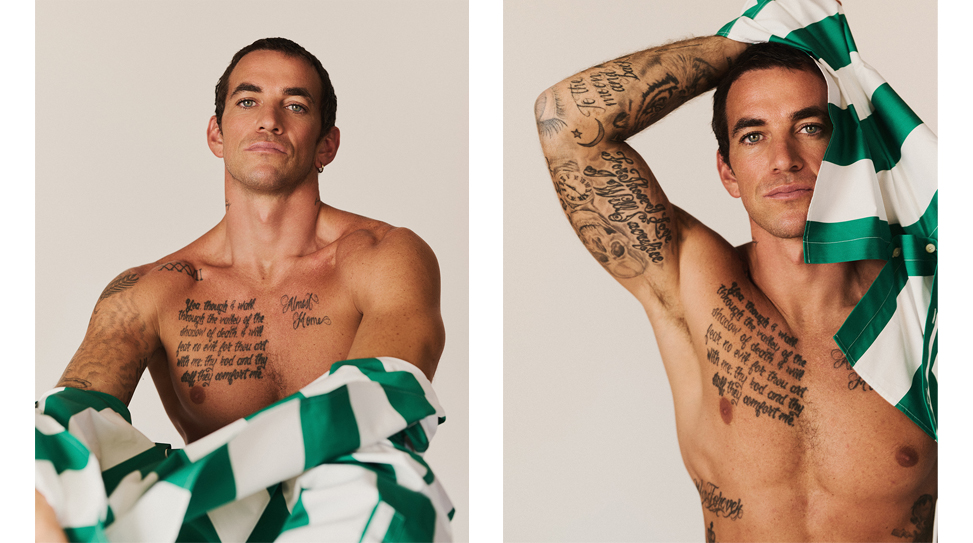

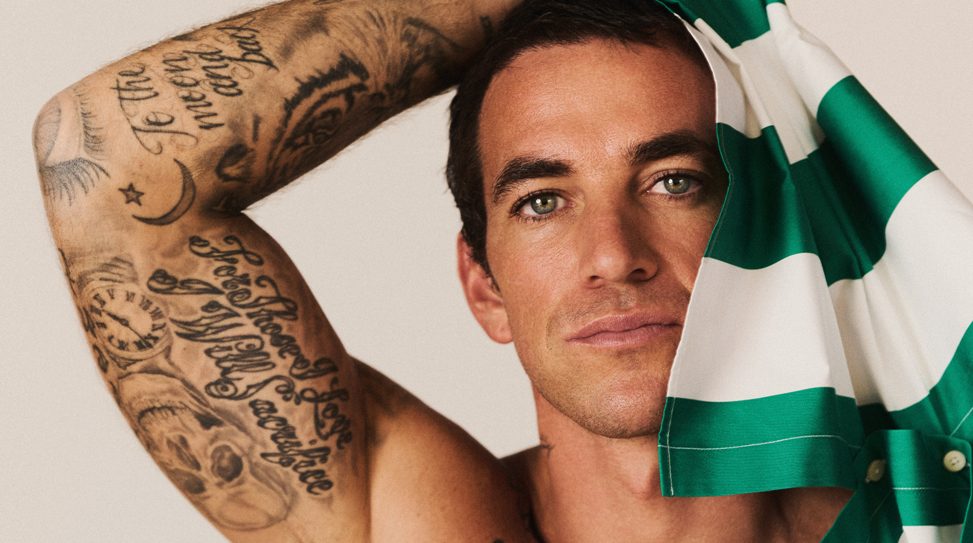

I would love to do a comedy. I’d love to do X-Men. A Bond villain. And this script I read called The Waffle House Index.
You Might Also Like
 Fatal Attraction
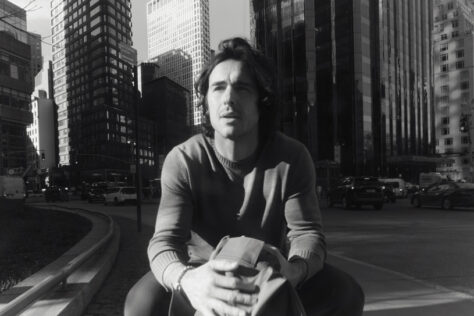 Man of the Moment
Photography by Pip at Monday Artists
Styling by Aimée Croysdill at With Falcon
Grooming by Charlie Cullen at Forward Artists using Saira skincare and Kevin Murphy
Global Brand Ambassador: Kee Chang
Special Thanks to Christina Kohl, Lydia Savva, James Jamieson & Olivia Garnham
Walk into any room and you can spot them immediately: people who pull you into their orbit. They do so without calculation or cunning but effortlessly. They are pleasant to be around. It is the allure of their mystery. It is a whole vibe. In psychology, they call this positive affective presence.
Alex Fine is one of those people. It is a good thing, too, considering the actor’s easy charm and magnetism have played no small part in his trajectory. Nor is he without ambition, of course, or “delusional hope,” as he likes to call it. In 2021, Fine made his debut as Grady, the leader of a crew of drovers, in Taylor Sheridan’s 1883. Now he returns as Donnie, an enigmatic adversary to Tom Hardy’s fixer, in the second season of MobLand following the show’s successful launch last year.
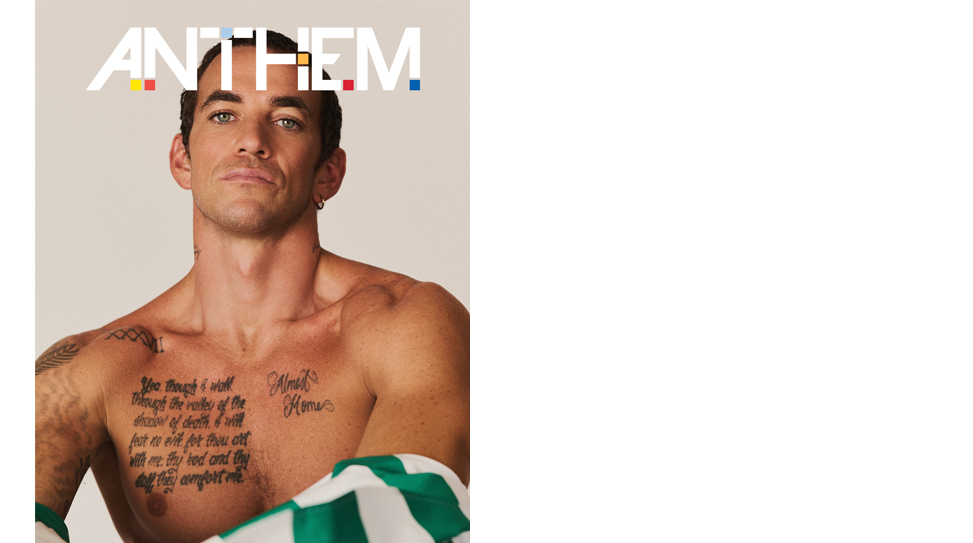
Anthem recently caught up with Fine in London for an in-depth conversation and cover shoot.
MobLand season two is currently underway with new episodes releasing through November 20.
[Editor’s Note: The following conversation has been edited and condensed for length and clarity.]
I don’t know if you hear this a lot, but you seem very mysterious.
I’ve gotten that a couple times…
It is a quality. And I think it’s great, considering the kind of character you play on MobLand.
Yeah, that works out. In the first season, you don’t know at all what Donnie’s intentions are. You don’t really know who he is. So I guess that helped in introducing the character.
So much of the mystique of actors is lost in our age of social media.
I would say so. I don’t know if this interview’s gonna help with the mystique. [laughs]
I certainly want to know more about you. I checked out your recent piece with Numero Netherlands. You lived in Los Angeles for eight years? Where is home nowadays?
Mostly Europe. But for the past two years filming MobLand, London has kind of been home.
You also spent some time in Chioggia, Italy this summer. You were filming a movie?
Yeah, Sentimental Fail Club. We shot it in Austria, Italy, Berlin, and Nashville. That was fun.
So not least for work, you’re a traveler.
Yeah. And growing up, I never really went on vacation.
If we can go back there, you were born in Cincinnati and raised in Lake Orion, Michigan?
I wasn’t raised in Lake Orion. I just spent six months there. I was really raised in Cincinnati.
But I was excited to tell you I was your distant neighbor growing up near Minneapolis…
Sorry. [laughs] I spent my whole life in Cincinnati. Cincinnati is quite a bit away.
Growing up, is this the kind of life you were dreaming about? What did you dream about?
This was always the dream. But it felt unattainable. There was no one I knew in Cincinnati or Northern Kentucky that had done it. For those who don’t know, Cincinnati and Northern Kentucky are two minutes away, closer than South London is to North London. There wasn’t anyone from that area who did this and made it, or did anything in the arts, that I could emulate. There was no outlet for it. Athletics is what Cincinnati was known for. Sports, pro athletes, stuff like that.
You played Division I football at Central Michigan University, on the track to going pro.
The dream was going pro. But there was this guy—Antonio Brown. I had to go against him one-on-one. I quickly realized that, no matter how hard I worked, my max potential was Division I.
I think you broke a lot of bones.
Nose, orbital, fingers, shoulders…
Luckily, what you really wanted to do was act.
You just hope that you’ll get the opportunity. But you don’t even know how that opportunity will shake out. With sports, it’s pretty linear. If you’re good in high school, you’re gonna get a scholarship. From there, you have a shot to the NFL. There are steps. It’s really based on talent and potential. It’s very black and white in sports, compared to acting where it’s based so much on other people’s opinions. In acting, there’s no real stats or attributes you can attain to make it concrete.
Meanwhile, you studied entrepreneurship. What were you planning to do with that degree?
This is gonna sound bad, but that was the easiest degree I could get without going to class. For what I wanted to do in life, I wasn’t going to study engineering or anything. So my degree was football, basically. I actually double majored in entrepreneurship and military science with a minor in Spanish. I couldn’t tell you much about any of those. [laughs] But I got a degree at the end of it.
As you say, acting isn’t linear like football. That’s an absolute in a field mired by uncertainty.
It’s very hard to break in or to get your first shot. And once you do, you have to trust your gut instinct with it. You can’t overthink stuff. My first audition was for 1883. I did that in a closet in my house. It was the quietest place, with terrible lighting. You just trust that what you’re doing is right. I don’t need a pristine backdrop or a great camera. 1883 was the first job I got.
What do you remember from your first day on the job?
I came in with torn groins from bull riding. I was in miserable pain. I was just focusing on not wincing whenever I sat on the horse. Also, I hadn’t met anyone yet so when Sam Elliot came up on his horse next to me, I was like, “It’s so great to meet you. I love your work. My name is Alex.” Blah blah blah. He looks at me and goes, “We’re rolling.” That was my first take ever.
You’ll remember that one. So, bull riding—is that what you were doing out in LA?
Yeah, bull riding. That’s when an agent at WME asked if I’d auditioned for anything before. I said, “No, but I would like to.” He told me about this Yellowstone spin-off that was coming out. So that’s how I got that job. It was surreal. Taylor Sheridan is awesome. I was very appreciative that he didn’t choose a big name over me, because you could cast anyone in that role if you wanted to.
And how does personal training fit into all of this?
Well, I didn’t really do personal training.
As you know, the media likes to portray you as a former celebrity personal trainer.
But it was never really that. I just had a gym in my garage. My friends came over and worked out.
To be fair, guys like KJ Apa are far from ordinary.
When they were doing TV shows and didn’t wanna go to a gym like Equinox because they worried about photos being taken of them or whatever, they would come over to my garage. I have a gym at the house I’m at now and it’s the same thing. My friends come over and work out with me.
Speaking of friends, how did you meet Peter Berg? You did American Primeval together.
We became close after sparring each other. He broke my nose twice, sparring and boxing.
He officiated your wedding, didn’t he?
Yeah, he was the ordained minister at my wedding.
You have a lot of people in your corner. You have a way of pulling them into your orbit.
I hope so. That would be nice. That’s a good compliment.
Let’s talk about MobLand. How did this show come to you?
Anthony Byrne, who directed Peaky Blinders and just wrapped on Shogun season two, sent me the audition. He had photographed me riding horses in Compton. He called me: “There’s this part on MobLand. I don’t know where it will take you, but send me a tape right now.” I didn’t know what was happening. Then I got a call from the show: “Can you get to London in two days?”
You never know where your next opportunity is coming from. How do you cope with that?
Going from season one to season two of MobLand was nice, having the security of knowing you’re coming back to something great. But I have delusional hope in everything I audition for. I’m confident that I’ll have a pretty good shot at doing something cool next, whatever that may be.
“Delusional hope”—is that something you can put into practice without predisposition?
I like to quote this: “Hope is not a tactic.” Because you can’t just show up and be like, “I hope this goes great today.” You actually have to prepare. If you’re prepared to the best of your ability and do as much as you can possibly do, then at that point you just gotta trust that the way you do it and the way you prepared is the best version. At the end of the day, you gotta believe in yourself and that you can do it. If you don’t believe it, then the people around you aren’t gonna believe it.
Like you, Donnie is mysterious. What was the pitch? Who did they want you to play?
They didn’t really know. I think they had the first two or three episodes written originally. But they brought up Ryan Gosling from Drive is what Anthony told me. I’m like, “Alright. That’s perfect.” Then I don’t remember who, but someone else told me, “Ray Donovan from Ray Donovan.”
Stoic. Quietly intimidating.
Yeah, yeah.
And then you fill in the blanks. What is his backstory? What are his life circumstances that brought him to this sort of job? Because maybe we won’t ever find that out on the show.
Yeah, maybe you’ll get an answer to that this season, maybe you won’t.
The important thing is that you know in order to play it.
And I could be wrong, or rather, it could be different from what Jez Butterworth had in mind. The way I thought about Donnie is that he has a militant background with a three-letter agency like the CIA or FBI. He has a checkered past. He was hired by Kat so he has to be some sort of a mercenary. He’s intelligent. He’s charming. He has to blend in as an everyday person as well.
I also quite enjoy how different Donnie’s temperament and approach is to Kat’s other hire, Johnny Flynn’s Frankie. Frankie is flamboyant and unhinged with loud quirks.
It’s funny how Johnny and I first met. We hadn’t known each other at all. We were both doing something at the Berlin Film Festival and ended up on the same flight back to London. So I see this guy sit down next to me. This guy has a weird haircut. I didn’t recognize him as Johnny Flynn at all. I’m like, “This guy has to be an actor. There’s no way someone gave him that haircut if not.” [laughs] I was like, “You working in London?” He’s like, “Yeah.” I was like, “Are you filming there?” He’s like, “Yeah.” I was like, “Are you doing MobLand?” He’s like, “Yeah…” I’m like, “Are you Frankie?” Then our flight got rerouted. We were three hours outside of London by that point. And they lost our luggage. We became close after that trip. It was happenstance.
About that ridiculous haircut: we seldom think about actors walking around with it at all hours. The first time I gave that serious thought was years ago when Franz Rogowski said to me, wearily, “I hate my haircut,” on a photoshoot. He was still in character at the time.
It happens. When I was thirty pounds heavier with a full beard and long hair for American Primeval, I saw an actor I was working with at a gas station so I went up to his car to talk to him. The gas station manager came out thinking I was homeless, asking the guy for money. He was like, “Get away from his car! Stop loitering!” I was like, “Man, I need to shave this off…”
You don’t have that problem with Donnie. I’m excited to see how your arc plays out this season. I think we’re on the cusp of seeing what he’s truly capable of. What can you tease?
[long pause] Nothing.
Totally fair. What about your process? If I looked at your desk, is it littered with things?
My desk is empty apart from the script pages. Usually, I’ll call a buddy from back home and take up an hour or two of their time practicing and rehearsing lines. I also use this app called WeAudition where I pay an actor or a reader to go back and forth on the lines with me for hours. I practice in different tones and voices. They don’t see my face. I’ll also get help from teachers at RADA, which is awesome. I also have bonfires outside at night and go over lines in my head.
What’s your connection to RADA?
So, I never applied to attend, but I also just wanted to study with them. We don’t really rehearse on any of the shows. I was lucky enough to be able to use RADA and their instructors for rehearsing, and also to go over the script and all that. I still use them for dialect and movement now.
RADA is a prestigious school. It’s very sought after.
You know what it was for me? I wanted a good dialect coach and Emma Woodvine is there. She’s sick. She helps me with literally everything. She’s unreal.
On the topic of language, you are the sole American actor on MobLand. Do you get curious, especially on a show with this ensemble, about the process of your international colleagues?
No.
No?
Not really.
Well, now you’re just being honest…
[laughs] I have actually never thought about it. I never asked or wondered what they do. I wouldn’t wanna change what I’m doing, I guess, so I don’t think I would wanna know what they’re doing.
You do what works for you. Congratulations on season three being greenlit, by the way.
Everyone seems to like season two so far. I’m excited for it to come out week by week.
Hypothetically, if you return in season three, what do you want to explore with Donnie?
It would have to be whatever Jez writes, to be honest with you. I wouldn’t even wanna think about it because he probably has a cooler version of it. To be fair, what I had imagined for Donnie going from the first to the second season was completely different. When I read it, I was like, “There’s a reason why Jez is the best.” So I don’t need to think about it. I trust whatever he has in store.
Broadening out from the show, what do you want to explore as an actor moving forward?
Honestly, I would love to do a comedy. I’d love to do X-Men. I loved Gambit growing up. A Bond villain. And this script I read called The Waffle House Index. I think all those would be really cool.
For those who don’t know, what is the Waffle House Index?
It’s used to measure the severity of natural disasters. The index comes from Waffle House, the restaurant. Their green menu means the restaurant is operating normally. Yellow means the restaurant is open, but with a limited menu. If they’re in the red menu, we know we’re in really rough shape. The crazy thing is that minimum-wage workers have to show up at all and cook waffles during a hurricane. I was a rescue diver during Hurricane Harvey in Houston. So I knew about this index from nine years ago when I would sometimes sleep in Waffle Houses. I was in five red zones. If it was red, we couldn’t even stay there. Also, I love Waffle House. [laughs]
That script was on the Blacklist. I only know about it because Inde Navarrette got cast.
Yeah, it’s definitely one that I’m super interested in.
If I ever open up Variety and see, “Alex Fine joins The Waffle House Index,” I’ll jump up and down for you. Also, as a longstanding fan of X-Men, I think you would make a great Gambit.
Just being a part of something that big would be amazing.
What is the measure of success to you in acting?
One of the reasons why I like acting, in projects big or small, is because you extend your life through legacy. Film lives forever. If you’re a writer, words live on. My grandchildren five generations away can watch me move and hear me speak without having ever met me or known who I was. That’s made tangible. That generations of your family can be connected in that way is cool. So that’s the barometer of success. I want to work with great people to continue making stuff that are timeless like 1883, American Primeval, and MobLand. They’re great now, great forever.
Being immortalized on film is like cheating death.
It’s the same concept central to that Pixar movie with the Day of the Dead.
Coco.
Yeah. You don’t truly die until the last person forgets you.

No Comments